



Artificial Intelligence (AI) is the hot topic right now – and rightfully so.
Just look at the world’s biggest marketing stage: of the 66 multi-million-dollar advertisements aired during the 2026 Super Bowl, 23% were either created at least in part with AI or were advertising for AI services [source]. The message to the world was loud and clear: if you aren’t using AI yet, you soon will be.
Here’s the good news: marketing and communications experts are in a unique position to be able to embrace the developments in AI technology while remaining staunch advocates to do so ethically. Trust in brands and spokespersons matters. And beyond this technology triggering that “uncanny valley” feeling in many people – remember the Jurassic Park/Xfinity ad? – we must find a way to embrace the pros while managing the cons.
The Public Relations Society of America recently updated its guide on The Ethical Use of AI for Public Relations Practitioners with the latest recommendations on the opportunities and challenges we all face in the AI space. In it, they repeatedly call out the need to keep humans in the AI content creation pipeline to ensure standards, policies, and values are maintained. In other words, humans need to do more than just prompt a response and expect it to be brilliant with no errors.
Let’s break down the key takeaways from the document that you need to consider for your own work.
Acknowledging AI as an Asset
Raise your hand if you’ve ever been working on a project, and you’ve:
- Felt overwhelmed by the ideas popping into your head
- Stared at a blank document, willing it to write itself or at least get you beyond the first words
- Struggled to remember the name of the article you read, who knows how long ago, that now would be perfect to reference
- Re-read the same data five times and struggled to get to the “so what” of the info
AI can be helpful in kickstarting ideas, content, research, and summarizing information to allow you to start diving deeper.
It can be especially useful in:
- Idea generation and concept exploration
- Initial research gathering/interpretation
- Kickstarting your creativity with prompts
- Resource analysis and/or comparison
- Personalization of existing content
These creativity and insight sparks are able to begin the process for you to get unstuck and get back to work. AI can absolutely have a place as a workplace companion tool, just make sure it isn’t the only one you use. In case you forgot, you have a pretty great head on your shoulders as well!
Why Ethical AI Use Matters
AI has transformed the way we communicate. Sure, it’s been unleashed in stand-alone applications such as ChatGPT, but the really impressive part is how integrated it is into countless applications we use daily. Search engines, Canva, LinkedIn, Facebook, Slack, Microsoft Suite, Google Drive, Grammarly…these and countless others now have their own fancy AI buttons built in.
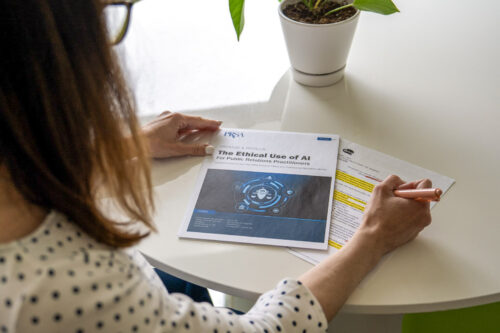
With so much access to AI both on the professional and personal front, now is the time to align on what AI use means for your organization and the ways you can ensure your employees, volunteers, contractors, and others are responsibly utilizing these tools. The PRSA guide emphasizes the need for Public Relations/Communications/Marketing professionals to step up as the ethical gatekeepers of the adoption of this technology because otherwise, the speed of the evolution of these tools (and the creation of others) will leave you in the dust. To be clear: you should not be alone in advocating for this, as it will require the full team, including leadership, information technology, and many others.
The Ethical Risks to Identify and Mitigate
We hate to break it to you, but there are, in fact, risks to this technology, just like any other. For some reason, many just skip the part of holding a comprehensive review and risk mitigation plan for the “what ifs” of this platform. Just to reiterate: ignorance is not a risk mitigation strategy.
Some major points to consider:
- Proliferation of misinformation
- AI has the ability to connect to everything at lightning speed – but data out is only as good as data in, which means sometimes, AI will get it wrong. How confident are you in the data inputs you have?
- One misstep or misstatement, even on an employee’s personal social media, can exacerbate this.
- Bias in the system
- Using AI does not mean stereotypes and biases cannot occur in the system. In fact, biases are a known issue in AI models. We must also ensure that our prompts do not include bias. Check out this blog from Johns Hopkins to learn more.
- Privacy and data exposure
- Information entered into public tools is not subject to the protections your organization ensures in other systems. Information into a public system = public information.
- Copyright issues
- Generative AI may use copyrighted works, including sounds, text, and images, to create its outputs. Or worse, it can make edits to your own brand’s materials (ever seen a slightly off version of your company logo?). This can easily dilute a brand and its messaging or even open you up to litigation.
So carve out some time on your calendar and review these topics with a lens specific to your organization. A good starting place is to proactively add content to your policies, training, and communications with your team. Just because you aren’t saying anything about AI, doesn’t mean your team isn’t already using it.
Need some steps to get started? Get started by:
- Getting humans involved throughout the entire process from start to finish.
- Then, train them on what ethical and proper use is and isn’t. Don’t leave them guessing. And importantly: make sure the training is reflected in your internal policy on AI use. Don’t have one yet? You can always start with researching one and customize for your organization.
- Ensure AI outputs are reviewed and verified prior to publication. Give your humans a chance to truly review and dig into what was created – see the next section on why this is so important.
- Avoid entering confidential information into AI platforms, especially those external to your systems. Your IT partners can really help here with specific recommendations. Some platforms will enable “no model training on your content” by default, but for others that is a paid-tier option. User beware!
- Be transparent about utilizing AI when appropriate. Especially if you provide a service for customers. It could be as simple as adding a disclaimer…or your client may have an outright ban on AI. Better to ask first to be clear on the expectations.
High-Trust Organizations Need to Stay Vigilant
Organizations whose mission is built on public confidence and critical relationships have the need for ethical AI use both magnified and expedited. Not talking about it yet? You need to be.
This is true for some of our own LMC clients across high-trust sectors such as healthcare organizations, nonprofits, community institutions, and professional services such as law firms. These groups, and the communities they serve, thrive on an unshakeable foundation of trust and credibility. Any issues around data/privacy breaches, misinformation, or bias can have severe and lasting consequences that may include legal repercussions. Credibility that has been built for years can be undone in moments, which is why ethical AI practices have to be a key component of any reputation management strategy.
Need a real-life example?
There is at least one new story a week highlighting a case where an organization relied on AI but completely left out the human aspect. Since it is graduation season, here’s one where a community college relied on AI and ended up in a mess: Leaders booed after AI botches Glendale Community College graduation. Don’t put yourself in this situation; be prepared or better yet, be proactive.
How Our Agency is Approaching AI
We strongly believe that AI tools have a place to help enhance what we do. It’s a companion tool that can help streamline brainstorming and research processes, assist in analysis, and provide a way for us to better manage our own internal workflows. Who doesn’t want to find more time in their day? But make no mistake – humans are still in the driver’s seat.
Our policies on AI address both the generation and review processes, as well as providing guidance on the amount of AI-generated content that is acceptable. Human review, editing, and approval of all content remains mandatory, and the strategy and messaging remain human-led.
Above all, we know that it is critical to stay grounded and review our approach frequently to stay in lockstep with the evolution of AI. Just look at how quickly this technology has become integrated into your personal and professional life.
AI is an incredibly powerful tool for efficiency and creativity, but it does not, and cannot, replace human responsibility and judgment.
Success for organizations deploying AI tools will not be achieved by those adopting AI the fastest, but by those using it the most thoughtfully. Done well, it can make our work more informed, more connected, and more human – not less.

How We Build Websites
We build websites to be proud of. These aren’t your typical template, cookie-cutter, or DIY websites. Your business is unique and your website should be too. That’s why we build custom websites, from the ground up.
Read More
Adapting Our Practices During a Pandemic
The uncertainty of COVID-19, paired with the unforeseen challenges of owning/operating a business is enough to make anyone panic. Times are different, and it's only natural that the marketing and advertising atmosphere has shifted as well.
Read More
Behind the Strategy: Barbour Behavioral Health
To showcase BCHA's rapidly expanding behavioral health department, we developed an integrated video campaign to spread the word about these specialized services now available in the community.
Read More